






Beer isn't just about hops!
Behind every sip of beer lies a series of chemical and biological reactions in which enzymes, sugars, and microorganisms transform simple grains into complex beverages. Pop the cap off your bottle or open your can, sit back, and follow along.
“What is the main ingredient in beer? ” When asked this question, nine out of ten people answer, “Hops! ” And that’s… wrong! The flower of this plant is certainly essential to beer, but it’s actually the ingredient used in the smallest quantity.
The Four Musketeers
Beer is based on four fundamentals: water, grains (mainly barley), hops, and yeast. In France, regulations require that beer be made from starchy raw materials, namely grains containing starch. Malted barley is the traditional choice, but the law permits wheat, rye, oats, corn, or rice.
Malt: Much More Than Just a Grain
At the heart of every beer is malt. To produce it, barley grains (or those of another grain) are germinated, then dried in an oven to halt germination. This process activates enzymes present in the grain, which will convert the starch into fermentable sugars during brewing. Depending on the duration and temperature of the drying process (or “kilning”), different malt profiles are obtained. Pale malts (pilsner or pale ale), dried at low temperatures, form the basis of brews and provide the sugars needed for fermentation. Caramel and crystal malts are dried in an oven at a higher temperature, caramelizing the sugars in the grain. They add sweet notes, body, and an amber color. Roasted malts (chocolate, coffee, black malt) are dried at very high temperatures. They give stouts and porters their black color, along with aromas of coffee, bitter chocolate, or licorice. Smoked malts are dried with wood smoke. They give certain beers (notably Rauchbier) a distinctly smoky flavor profile. Unmalted grains are also used: oat flakes to add body and a velvety texture; raw wheat for the lightness and characteristic cloudiness of wheat beers; and corn or rice to lighten the structure.
Brewing:WhenStarchBecomes Sugar
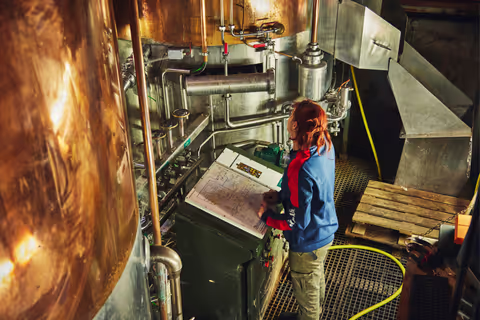
Itbegins with the crushing ofcoarselyground grains to releasethe starch. Next comes mashing: the crushed malt is mixed with hotwater in atank,oftenmade of stainless steel. At temperatures between 62 and 72 °C, the enzymes in the malt (amylases) break downthe starchinto simpler sugars, mainly maltose. Oncemashingis complete, it’s time for filtration: the sugaryliquid, calledwort, is separated from the grainresidue ( spent grain) ,which is recycledintoanimalfeedorfoodflour. As forthe wort, it is transferred to aboilingkettle, where it is boiled for 60 to 90 minutes. This process sterilizes the wort, stabilizescertainproteins, and— this is where the hopscomein.
Hopping:The Art of Measurement and Timing
Hops (Humuluslupulus) are avinewhosecones(the femaleflowers )are used,eitherdriedor in pellet form .They serve a dual purpose, and the timing of their addition is crucial.Early in the boil (60 to 90 minutes), the hopsarereferred to as“bittering hops.” Theiraromas evaporatecompletely during the boil.Toward the end of the boil ( added during the last10 to 15 minutes), the hops do not contribute much bitternessbutretaintheiressentialoils. These are the aromatichops, which give the beeritsfloral, fruity, herbaceous, orresinous notes ,depending on the varietyused.Finally, dryhopping involves addinghopsdirectly to the beer after boiling, during fermentation or aging, without anyheat. No addedbitterness, butanaromatic explosion (mango, passion fruit, pine resin, citrus, etc.) thatboilingwould destroy.
Fermentation :The Yeast Does Its Job
After boiling, the wort is quicklycooledand thentransferredto a fermentation tankwhere it is inoculated with yeast. Thesesingle-celled fungi consume the sugars and ,in return, producealcohol and CO₂. There aretwo types of yeast, and the choice between themdetermines the beer’sprofile.Top-fermentation (ales):Saccharomyces cerevisiaeferments at temperatures between 15 and 25 °C and tends to riseto the surface. Fermentation is rapid (4 to 8 days) and producesfruity esters and spicyphenols. Pale ales, IPAs, stouts, wheatbeers, Belgianbeers, and othersusethis type of fermentation.
Bottomfermentation (lagers):Saccharomyces pastorianusferments at temperatures between 4 and 12 °C and settlesat the bottom of the tank. Fermentation is slower, the aromasproducedaresubtle, and the result is aclean, lightbeer. Mostcommercialbeersarelagers, which are bottom-fermentedbeers.
Filtration: A Matter of Clarity
Onceprimary fermentation is complete, the beer still contains suspended yeast, proteins, and otherparticles that cloud it . Depending on the desired style , the brewermaychoose to filter it or not. Filtrationproducesa bright, clearbeer, butit canalso removesome of the aromas and complexity.Notably,New England IPAs (NEIPAs)areunfiltered, and their cloudiness is a markof authenticity. Othertraditional styles , such asBavarianwheatbeers (Hefeweizen), are requiredby regulationto remain on their yeast sediment .
Aging:Patience asthe SecretIngredient
Certain styles requirea aging period — that is , maturation at lowtemperatures—before being bottled. This is the case with lagers (the termcomes from the German wordlagern, meaning “to store”). During this phase, which lasts from a fewweeks to severalmonths, the residualyeastcontinues to workslowly, eliminatingcertainundesirablecompoundssuch asdiacetyl, which gives a rancid,buttery taste . The beermatures, becomes smoother, and itsflavorsblend and harmonize. Great age-worthy beerscanthus spend three to sixmonthsin the cellar before being sold.
Packaging: Bottle, Can,orKeg?
The bottle is the most traditionalcontainer. It allows for secondary fermentation in certain styles (Belgianbeers, English ales), which develop natural carbonation and additionalaromasas a result. Glass protects the beer well ... but not from light, which cancauseundesirablechemicalreactionsinjusta few minutes . This is the famous “light -struck”effect that gives somebeers— especially those in green orclearbottlesexposed to sunlight — a skunk-like taste and destroys their lovelyhoppy notes . The keg is the goldstandard for draft beerservedat bars and guaranteesexcellentfreshness. The beer is stored under CO₂ pressure (ora mixture of CO₂ and nitrogen for certainbeers, such asIrish stouts , which produceacharacteristiccreamy head ).
Longshunned, the canhasestablished itselfas the bestcontainer for qualitybeer. And it’s not just afad—it’s physics and chemistry.Completely opaque and perfectlyairtight, itcoolsfaster and retainsits carbonationbetter over time. What’s more, it’s unbreakable, lightweight, and infinitelyrecyclable without any loss of aluminumquality.For ultra-aromaticbeerslike NEIPAs ordelicatebrews, the can is the choice of the most discerning breweries .
This article is excerpted from Gault&Millau magazine,issue no. 14. It is available at the Gault&Millau online store.